Eurasian Golden Oriole (Oriolus oriolus) — Identification, Song, and Facts LC
Overview
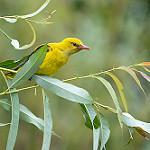
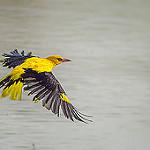
The Golden Oriole (Oriolus oriolus) is one of Europe’s most strikingly beautiful and elusive birds. With its vivid yellow plumage and rich, flute-like song, the male golden oriole stands out among woodland birds. Despite its bright colors, it’s surprisingly hard to spot, spending much of its time high in leafy treetops. The species is migratory, arriving in Europe in late spring and leaving for Africa by the end of summer.
Habitat and Distribution
Golden orioles breed throughout most of Europe (except the far north), extending east into western Asia and parts of the Middle East. They prefer deciduous and mixed forests, river valleys, orchards, and large parks. Their ideal habitat includes tall trees with dense foliage — perfect for nesting and foraging.
Wintering Grounds and Migration
Being long-distance migrants, golden orioles spend the winter in sub-Saharan Africa, particularly in savannas and light woodlands. Migration occurs mainly at night. They return to Europe around May and leave again in August or early September.
Appearance and Identification
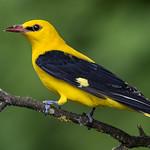
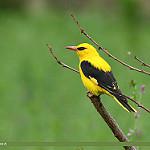
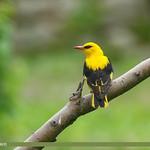
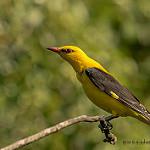
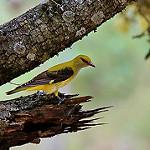
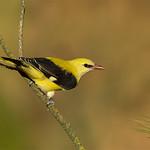
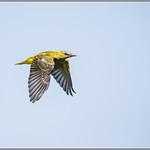
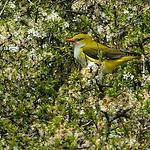
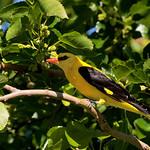
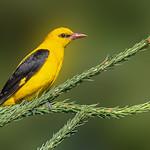
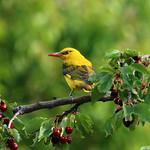
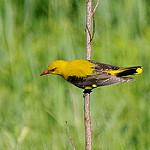
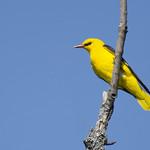
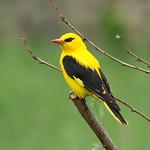
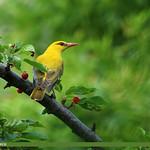
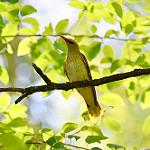
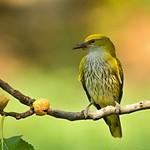
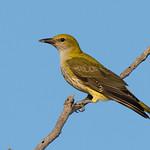
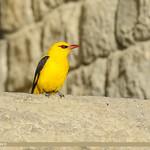
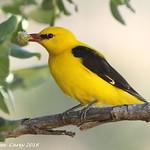
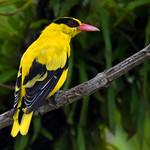
The golden oriole measures about 24 cm in length with a wingspan up to 45 cm and weighs approximately 65–70 grams. Males are brilliant golden-yellow with black wings and tail, and striking red eyes. Females are greenish-yellow with less contrast, offering better camouflage in foliage. Juveniles resemble females but have faint streaks on the chest.
Song and Voice
The golden oriole’s song is among the most distinctive in Europe — a melodious, flute-like whistle often transcribed as “wee-loo” or “pee-loo.” The male sings from the treetops, especially early in the morning and at dusk. To hear authentic recordings of oriole songs, scroll down.
Behavior and Lifestyle
Golden orioles are shy and prefer to stay hidden in the canopy. They rarely descend to the ground, feeding mostly in the middle and upper levels of trees. These birds are diurnal and highly territorial during the breeding season. Despite their strong, clear song, they are more often heard than seen.
Diet and Feeding
The golden oriole is an omnivore. Its diet includes:
- insects (beetles, caterpillars, flies, grasshoppers);
- spiders and small invertebrates;
- fruits such as cherries, mulberries, and figs;
- occasionally nectar and flower parts.
Orioles help control insect populations and act as natural seed dispersers, playing an important ecological role in forest ecosystems.
Breeding and Nesting
Breeding season begins in late May or early June. The female builds a remarkable hanging nest suspended between forked branches — a deep woven cup made of grass, bark strips, and plant fibers. She lays 3–5 eggs and incubates them for about two weeks. Both parents feed the chicks, which fledge roughly 15–17 days after hatching.
Interesting Facts about Golden Orioles
- The male’s pure yellow plumage inspired the bird’s name — “golden oriole.”
- Despite their vivid color, orioles are extremely difficult to spot due to their canopy-dwelling habits.
- They are among the last migratory songbirds to arrive in Europe each spring.
- Their song is so melodious that it’s often compared to a flute or ocarina.
Conservation Status
According to the IUCN Red List, the golden oriole is classified as Least Concern (LC). The global population is stable, although local declines occur due to habitat loss and deforestation in breeding areas.
FAQ — Golden Oriole
Where do golden orioles live?
Golden orioles inhabit deciduous and mixed forests across Europe and western Asia. They build their nests high in trees with dense foliage and migrate to Africa for the winter.
What does the golden oriole eat?
Golden orioles feed on insects, caterpillars, spiders, and fruits like cherries and mulberries. They help regulate insect populations and spread seeds.
When do golden orioles migrate?
They migrate from Europe to sub-Saharan Africa in late summer (August–September) and return to Europe in late spring (May).
How can you recognize a golden oriole?
Males are bright yellow with black wings and tail, while females are greenish-yellow and more camouflaged. Their song is a clear, flute-like whistle often heard in summer forests.
- Synonyms Eurasian Golden-Oriole, European Golden Oriole, Golden oriole, Western Eurasian Golden-Oriole
- Old latin name for bird Oriolus galbula, Turdus luteus, Turdus aureus, Coracias oriolus
Eurasian Golden Oriolebird sounds *
Related species



Where to see Eurasian Golden Oriole
- Breeding region Eurasia
- Breeding subregion w Eurasia
- Non breeding region Africa
- Afghanistan
- Albania
- Algeria
- Andorra
- Angola
- Armenia
- Austria
- Azerbaijan
- Bahrain
- Belarus
- Belgium
- Benin
- Bosnia and Herzegovina
- Botswana
- Bulgaria
- Burkina Faso
- Burundi
- Cabo Verde
- Cameroon
- Central African Republic
- Chad
- China
- Comoros
- Congo
- Congo (the Democratic Republic of the)
- Croatia
- Cyprus
- Czechia
- Côte d'Ivoire
- Denmark
- Djibouti
- Egypt
- Equatorial Guinea
- Eritrea
- Estonia
- Eswatini
- Ethiopia
- Faroe Islands
- Finland
- France
- Gabon
- Gambia
- Georgia
- Germany
- Ghana
- Gibraltar
- Greece
- Guernsey
- Guinea
- Guinea-Bissau
- Holy See
- Hungary
- Iceland
- India
- Iran
- Iraq
- Ireland
- Isle of Man
- Israel
- Italy
- Jersey
- Jordan
- Kazakhstan
- Kenya
- Kuwait
- Kyrgyzstan
- Latvia
- Lebanon
- Lesotho
- Liberia
- Libya
- Liechtenstein
- Lithuania
- Luxembourg
- Madagascar
- Malawi
- Mali
- Malta
- Mauritania
- Mauritius
- Mayotte
- Moldova
- Mongolia
- Montenegro
- Morocco
- Mozambique
- Namibia
- Netherlands
- Niger
- Nigeria
- North Macedonia
- Norway
- Oman
- Pakistan
- Palestine, State of
- Poland
- Portugal
- Qatar
- Romania
- Russia
- Rwanda
- San Marino
- Sao Tome and Principe
- Saudi Arabia
- Senegal
- Serbia
- Seychelles
- Sierra Leone
- Slovakia
- Slovenia
- Somalia
- South Africa
- South Sudan
- Spain
- Sri Lanka
- Sudan
- Sweden
- Switzerland
- Syria
- Tajikistan
- Tanzania
- Togo
- Tunisia
- Turkey
- Turkmenistan
- Uganda
- Ukraine
- United Arab Emirates
- United Kingdom
- Uzbekistan
- Western Sahara
- Yemen
- Zambia
- Zimbabwe
- Åland Islands
Species Name in Other Languages
| Language | Translation |
|---|---|
| Abkhazian | аШымҳаүарақәа ᴘʟ , аШымҳаүыс |
| Afrikaans | Europese Wielewaal |
| Albanian | Bengu |
| Arabic | العين, صفارية اورسية |
| Armenian | Պիրոլ |
| Azerbaijani | sarıköynək, sarısandal, Adi sarıköynək, zərd |
| Bashkir | үтәбикә, зифа ҡош, һарығош |
| Basque | Urretxori, Urretxoria |
| Belarusian | Aвяльга, Авяльга |
| Bengali | ইউরেশীয় সোনাবউ |
| Breton | Glazaour, Ar glazaour |
| Bulgarian | Авлига |
| Catalan | oriol eurasiàtic, Oriol |
| Chinese | 金黄鹂 |
| Chinese (Traditional) | 金黃鸝 |
| Chuvash | сарă сĕлхе, саркайăк, сар кайăк |
| Cornish | Owrek |
| Croatian | vuga, Zlatna vuga |
| Czech | žluva hajní |
| Danish | Pirol |
| Dutch | Wielewaal |
| Esperanto | oriolo, Ora oriolo |
| Estonian | peoleo |
| Faroese | gyllingur |
| Finnish | kuhankeittäjä |
| French | Loriot d’Europe, Loriot d'Europe |
| Frisian | Gielegou |
| Galician | Ouriolo europeo, Ouriolo |
| Georgian | მოლაღური |
| German | Pirol-oriolus, Pirol |
| Greek | Συκoφάγoς, Συκοφάγος, Κλορκός , (Ευρωπαϊκός) Συκοφάγος |
| Hebrew | זהבן, זהבן מחלל |
| Hindi | Manja kili |
| Hungarian | sárgarigó |
| Icelandic | Laufglói |
| Irish | Óiréal órga, Órshóileach |
| Italian | Rigogolo |
| Japanese | ニシコウライウグイス |
| Kazakh | мысық-торғай, мысық торғай, сарғалдақ, кәдімгі мысықторғай, Мысықторғай |
| Latvian | vālodze |
| Lithuanian | Volungė, Volunge, eurazinė volungė |
| Luxembourgish | Piroul, Goldmärel |
| Macedonian | саријазма, Жолна |
| Malayalam | ഇന്ത്യന് മഞ്ഞക്കിളി |
| Maltese | orjoli, orjola, Tajra Safra |
| Manx | Ushag airhey |
| Mongolian | Эгэл шаргач, шарагч бялзуухай, алтан гургалдай, Шаргач бялзуухай |
| Northern Sami | Geassegollet |
| Norwegian | pirol |
| Norwegian Nynorsk | Pirol |
| Persian | پری شاهرخ, پریشاهرخ {اوراسیایی} |
| Polish | wilga (zwyczajna), wilga |
| Portuguese | Papa-figos, papa-figos-europeu |
| Romanian | Grangur |
| Romansh | Pirol |
| Russian | Иволга, Обыкновенная иволга, Иволга обыкновенная |
| Serbian | vuga zlatna, Vuga |
| Slovak | vlha obyčajná |
| Slovenian | kobilar |
| Spanish | Oropéndola europea, Oropéndola |
| Swahili | Kubwilu wa Ulaya |
| Swedish | sommargylling |
| Tatar | урман шәүлегәне , яңгыр чакыручы, шәүлегән , яңгыр теләнчесе |
| Tsonga | Ndukuzani |
| Turkish | Мысықторғай, Sarıasma |
| Turkmen | sargyldak |
| Ukrainian | Вивільга, вивільга звичайна |
| Uzbek | зарғалдоқ |
| Welsh | Euryn |