Western Barn Owl / Tyto alba LC
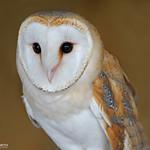
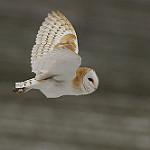
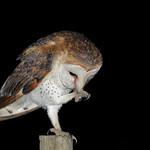
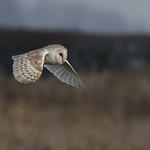
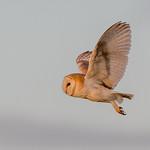
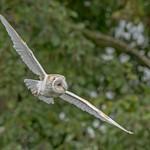
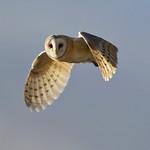
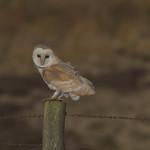
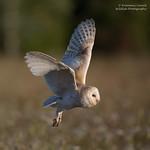
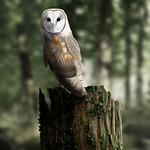
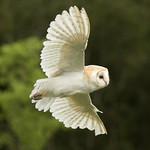
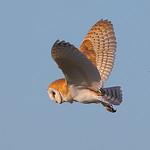
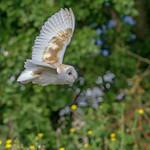
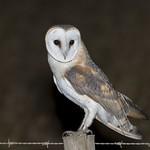
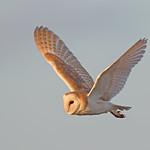
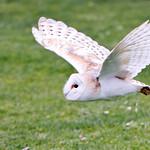
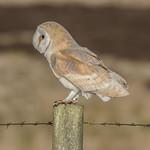
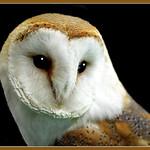
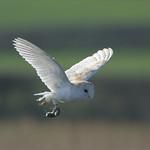
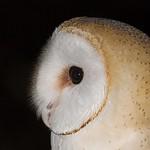
The Barn Owl (Tyto alba) is one of the most widespread and recognizable owls in the world. Its Russian name, "Сипуха", comes from its characteristic husky call. Known under various nicknames referring to its appearance, sounds, habitat, and silent flight, the Barn Owl is a nocturnal predator treasured by birdwatchers.
Taxonomy and Discovery
First described in 1769 by Tyrolean naturalist Giovanni Scopoli as Strix alba, it was later reclassified into the genus Tyto. Its scientific name, Tyto alba, literally means "white owl".
Appearance
Barn Owls are medium-sized among owls, with a distinctive heart-shaped facial disc, long legs, and slim body. Asymmetrical ear placement and silent flight allow them to locate prey precisely and hunt efficiently at night.
- Body length: 25–40 cm
- Wingspan: 85–95 cm (up to 110 cm in some regions)
- Weight: 188–700 g (average 300–350 g)
- Plumage: upperparts reddish-golden with ash flecks; underparts pale cream with small dark spots
- Heart-shaped facial disc — key identification feature
Voice and Behavior
During the breeding season, Barn Owls produce harsh, hissing and rattling calls. At other times, they are mostly silent. They may click their beak or flap wings to scare intruders. Audio recordings of Barn Owl calls are available on this page.
Range and Habitat
Barn Owls have an extensive range across Europe, Asia, Africa, Australia, the Americas (excluding the extreme north of Alaska and Canada), and many islands. They avoid high-altitude mountains and extreme cold. Usually, they are found in farmlands, open fields, barns, lofts, and other buildings where prey is abundant.
- Range: widespread globally, except extreme northern regions
- Habitat: farms, lofts, bell towers, cliffs, ravines, open fields near water
- Often lives near humans and uses buildings for nesting
- Island populations are often smaller and lighter due to ecological adaptation
Diet and Hunting
Barn Owls feed mainly on small terrestrial mammals: voles, mice, rats, and shrews. Occasionally they eat small rabbits, birds, lizards, and large insects. Hunting is mostly nocturnal, using acute hearing and sight, and sometimes by ambush from a perch.
- Main prey: voles, mice, rats, shrews
- Occasionally: small birds, lizards, insects
- Hunting strategy: silent flight, low-level patrols, ambush from perches
Reproduction and Life Cycle
Barn Owls are mostly monogamous, though polygamy has been reported. Courtship involves aerial displays and vocalizations by males. They do not build complex nests — often occupy tree hollows, cavities in cliffs, abandoned burrows, or lofts. Females lay eggs gradually, so chicks hatch asynchronously, giving older chicks a survival advantage when food is scarce.
- Clutch size: usually 4–7 eggs (up to 14 in exceptional cases)
- Incubation: ~30 days, mainly by female
- Hatching: asynchronous
- Fledging: chicks fed up to 3 months; sexual maturity at ~10 months
- Lifespan: average ~2 years; up to 11–17 years in favorable conditions (record in Europe: 17 years 11 months)
Threats and Conservation
Main threats include habitat loss, pesticide use, rodenticides, road collisions, and changes in agricultural landscapes. In some regions, Barn Owls are listed in national Red Books. Predators such as larger owls, hawks, and mustelids are a threat mainly to juveniles.
- Threats: pesticides, habitat destruction, loss of nesting sites
- Predators: owls, hawks, mustelids
- Island introduction: can disrupt ecosystems (e.g., Galapagos, Seychelles)
How to Help Barn Owls
- Install and maintain nest boxes (approx. 100×50×50 cm with a 12×15 cm entrance in the upper corner).
- Keep lofts and buildings accessible for nesting owls.
- Reduce pesticide and rodenticide use.
- Provide supplementary food in harsh winters if locally appropriate.
- Educate farmers and communities about the ecological benefits of Barn Owls.
Interesting Facts
- Barn Owls were introduced to some islands to control rodents, sometimes causing unintended ecological consequences.
- Island populations are often smaller than mainland birds.
- When humans approach, they may display “grimaces” and rocking movements.
- Although nocturnal, they sometimes hunt during the day in winter or while feeding chicks.
Frequently Asked Questions about the Barn Owl
Where does the Barn Owl live?
Barn Owls are widespread globally: Europe, Asia, Africa, Australia, the Americas, and many islands. They prefer farmlands, lofts, barns, and open landscapes with available prey.
What does the Barn Owl eat?
Mainly small terrestrial mammals: voles, mice, rats, shrews. Occasionally small birds, lizards, and large insects. They hunt mainly at night using acute hearing and vision.
Why is it called a Barn Owl?
The name "Barn Owl" comes from its habit of nesting in barns, lofts, and human structures, where rodent prey is abundant.
How to identify a Barn Owl?
Key features: heart-shaped facial disc, pale underparts, reddish-golden back with flecks, and soft, hissing call. Asymmetrical ears and silent flight are distinctive traits.
How can people help Barn Owls?
Provide nest boxes, limit pesticide use, maintain accessible lofts or hollow trees, and offer supplemental feeding during harsh winters if appropriate.
Where can I hear Barn Owl calls?
Audio recordings of Barn Owl calls are available for listening directly on this page without visiting external websites.
- Synonyms furcata], Barn Owl [incl. detorta, excl. stertens
- Old latin name for bird Strix alba, Strix flammea
Western Barn Owlbird sounds *
Related species

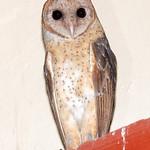
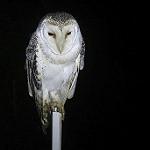
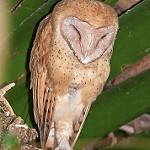


Where to see Western Barn Owl
- Breeding region Africa, Eurasia
- Breeding subregion widespread
- Afghanistan
- Albania
- Algeria
- Andorra
- Angola
- Armenia
- Austria
- Azerbaijan
- Bahrain
- Belarus
- Belgium
- Benin
- Bosnia and Herzegovina
- Botswana
- Bulgaria
- Burkina Faso
- Burundi
- Cabo Verde
- Cameroon
- Central African Republic
- Chad
- Comoros
- Congo
- Congo (the Democratic Republic of the)
- Croatia
- Cyprus
- Czechia
- Côte d'Ivoire
- Denmark
- Egypt
- Equatorial Guinea
- Eritrea
- Estonia
- Eswatini
- Ethiopia
- Finland
- France
- Gabon
- Gambia
- Georgia
- Germany
- Ghana
- Gibraltar
- Greece
- Guernsey
- Guinea
- Guinea-Bissau
- Hungary
- Iran
- Iraq
- Ireland
- Isle of Man
- Israel
- Italy
- Jersey
- Jordan
- Kenya
- Kuwait
- Latvia
- Lebanon
- Lesotho
- Liberia
- Libya
- Liechtenstein
- Lithuania
- Luxembourg
- Madagascar
- Malawi
- Mali
- Malta
- Mauritania
- Mayotte
- Moldova
- Monaco
- Montenegro
- Morocco
- Mozambique
- Namibia
- Netherlands
- Niger
- Nigeria
- North Macedonia
- Norway
- Oman
- Palestine, State of
- Poland
- Portugal
- Qatar
- Romania
- Russia
- Rwanda
- San Marino
- Sao Tome and Principe
- Saudi Arabia
- Senegal
- Serbia
- Seychelles
- Sierra Leone
- Slovakia
- Slovenia
- Somalia
- South Africa
- South Sudan
- Spain
- Sudan
- Svalbard and Jan Mayen
- Sweden
- Switzerland
- Syria
- Tanzania
- Togo
- Tunisia
- Turkey
- Turkmenistan
- Uganda
- Ukraine
- United Arab Emirates
- United Kingdom
- Uzbekistan
- Western Sahara
- Yemen
- Zambia
- Zimbabwe
- Åland Islands
Western Barn Owl subspecies (10)
| Subspecies | Breeding subregion | Nonbreeding subregion | Extinct |
|---|---|---|---|
| Tyto alba alba | nw Africa, w, s Europe to the Balkans | - | No |
| Tyto alba detorta | Cape Verde Is. (most islands; s Macaronesia, w of n Africa) | - | No |
| Tyto alba erlangeri | Crete and Cyprus through the Middle East to s Iran | - | No |
| Tyto alba ernesti | Corsica and Sardinia | - | No |
| Tyto alba gracilirostris | e Canary Is. (c Macaronesia, nw of n Africa) | - | No |
| Tyto alba guttata | c Europe and e Balkans to the Ukraine | - | No |
| Tyto alba hypermetra | Comoros, Europa (w of s Madagascar, Mozambique Channel) and Madagascar | - | No |
| Tyto alba poensis | Africa s of the Sahara, Bioko (n Gulf of Guinea is.) | - | No |
| Tyto alba schmitzi | Madeira, Porto Santo and Desertas (nc Macaronesia, nw of n Africa) | - | No |
| Tyto alba thomensis | São Tomé (sc Gulf of Guinea is.) | - | No |
Species Name in Other Languages
| Language | Translation |
|---|---|
| Afrikaans | Nonnetjie-uil |
| Albanian | Kukuvajka mjekroshe, Kukuvajka mjekëroshe |
| Arabic | بومة المخازن, الهامة |
| Basque | Hontz zuri, Hontza zuria |
| Belarusian | Сіпуха, Сiпуха |
| Bengali | লক্ষ্মী প্যাঁচা |
| Breton | Ar gaouenn wenn, Grell voutin |
| Bulgarian | Забулена сова |
| Catalan | òliba, Òliba comuna |
| Chinese | 西方仓鸮, 西仓鸮, 仓鸮 |
| Chinese (Traditional) | 倉鴞 |
| Cornish | Ula gwyn |
| Croatian | kukuvija |
| Czech | sova pálená |
| Danish | Slørugle |
| Dutch | Kerkuil |
| Esperanto | turstrigo |
| Estonian | loorkakk |
| Faroese | Hjartaugla |
| Finnish | tornipöllö |
| French | Effraie des clochers [incl. detorta, excl. stertens, furcata], Effraie des clochers |
| Frisian | goudûle |
| Galician | Curuxa |
| Georgian | ბუხრინწა |
| German | Schleiereule |
| Greek | Τυτώ |
| Guarani | Suinda |
| Hebrew | תנשמת, תנשמת לבנה |
| Hindi | Chavu kuruvi |
| Hungarian | gyöngybagoly |
| Icelandic | Turnugla |
| Indonesian | Burung Serak Jawa |
| Irish | Scréachóg Reilige |
| Italian | Barbagianni |
| Japanese | メンフクロウ |
| Latvian | plīvurpūce |
| Lithuanian | paprastoji liepsnotoji pelėda, Liepsnotoji pelėda |
| Luxembourgish | Tuermeil, Tuereil |
| Macedonian | кукувија, Кукувија, Кукавија |
| Malagasy | Tararaka |
| Malay | Burung Jampok Kubur |
| Malayalam | വെള്ളിമൂങ്ങ, വെള്ളി മൂങ്ങ |
| Maltese | Barbaġann |
| Manx | Caillagh oie, Screeaghag Oie |
| Nepali | गोठे लाटोकोसेरो |
| Northern Sami | Toardnaskuolfi |
| Norwegian | tårnugle |
| Persian | جغد انبار |
| Polish | Płomykówka, płomykówka (zwyczajna), plomykówka |
| Portuguese | coruja-das-torres-ocidental, coruja-da-igreja / coruja-das-torres, Coruja-das-torres |
| Romanian | Striga, Strigă |
| Romansh | Tschuetta velada |
| Russian | Сипуха |
| Serbian | Kukuvija, kukuvija obična |
| Shona | Zizi |
| Slovak | plamienka driemavá |
| Slovenian | pegasta sova |
| Spanish | Lechuza común |
| Swahili | Bundi Babawatoto |
| Swedish | tornuggla |
| Tamil | Koogai Andhai |
| Thai | นกแสก |
| Tsonga | Xinkhovha |
| Tswana | Lerubise |
| Turkish | Peçeli Baykuş |
| Turkmen | peçeli baykuş |
| Ukrainian | сипуха крапчаста, Сипуха |
| Vietnamese | Cú lợn lưng xám |
| Welsh | Tylluan wen |
| Xhosa | Isikhova |
| Zulu | isiKhova |