New DiBird mobile app is now available — iOS & Android
Better on the app — your life list in your pocket. Download DiBird free
Shoebill (Balaeniceps rex): Complete Identification Guide, Habitat, Behavior & Facts VU
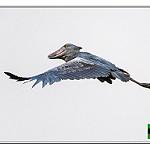
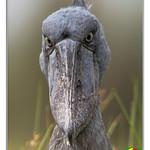
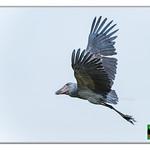
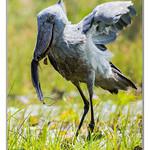
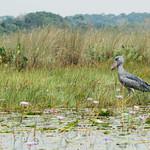
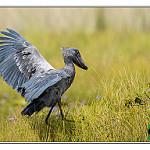
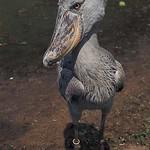
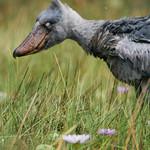
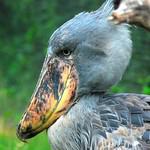
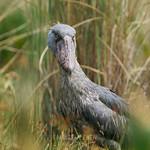
The Shoebill (Balaeniceps rex) is one of Africa’s most extraordinary wetland birds, famous for its massive shoe-shaped bill, statuesque hunting posture, and preference for vast papyrus swamps. This species attracts birdwatchers from around the world and is considered one of the most iconic wetland birds of tropical Africa.
Quick Species Overview
- Height: 110–152 cm
- Wingspan: 230–260 cm
- Weight: 4–7 kg on average
- Habitat: tropical freshwater swamps, papyrus wetlands, floating vegetation
Appearance & Key Identification Features
The Shoebill is instantly recognizable thanks to its oversized, shoe-shaped bill, powerful head, long legs, and tall silhouette. Adults have greyish-blue plumage, while juveniles appear browner. The species is also known for its slow, deliberate movements and prolonged stillness while hunting.
How to Identify the Shoebill
- massive shoe-shaped bill with a sharp hook at the tip
- tall stature with long legs for wading in shallow water
- grey or bluish-grey adult plumage; browner juveniles
- characteristic motionless hunting stance
Distribution & Habitat
The Shoebill inhabits large, undisturbed freshwater wetlands across central tropical Africa. Key regions include South Sudan (Sudd wetlands), northern Uganda, western Tanzania, the eastern Democratic Republic of the Congo, and parts of northern Zambia. The species prefers dense papyrus swamps with deep channels and floating vegetation mats.
Diet & Hunting Strategy
Shoebills primarily feed on large fish, including lungfish and catfish, but may also take amphibians, reptiles and occasionally small mammals. Their hunting strategy relies on stillness: the bird stands motionless for long periods before striking with a swift, powerful snap of its immense bill.
Main Diet Components
- large fish (including lungfish and catfish)
- frogs and other amphibians
- occasional reptiles
- small aquatic mammals when available
Breeding & Nesting
Shoebills breed on floating or slightly elevated platforms made of wetland vegetation. Pairs usually lay 1–3 eggs, though typically only one chick is raised successfully. Both parents incubate and care for the young. The species is highly sensitive to disturbance during nesting.
Behavior & Lifestyle
This species is known for its solitary or pair-based lifestyle, territorial behavior, and low tolerance for human disturbance. Shoebills perform local movements linked to water levels and seasonal availability of prey. Their patient, statue-like posture during hunting is one of their most iconic behavioral traits.
Why the Shoebill Fascinates Birdwatchers
Among birdwatchers, the Shoebill has near-legendary status as an emblematic swamp species and one of the most sought-after birds in African wildlife tourism. Its unusual appearance and elusive nature make it a highlight for any serious birder.
Similar Species
- large grey herons (similar size but narrow, pointed bills)
- saddle-billed stork (large and striking, but very different bill shape)
Interesting Facts
- their bill is one of the largest and most powerful among modern birds
- Shoebills can remain perfectly still for hours while waiting for prey
- wingbeats are surprisingly slow for such a large bird, giving them a prehistoric look in flight
FAQ — Frequently Asked Questions
Where can I see a Shoebill in the wild?
The best places to see Shoebills are large tropical wetlands in central Africa, especially the Sudd region in South Sudan, northern Uganda, western Tanzania, and parts of the eastern Democratic Republic of the Congo. Look for deep channels surrounded by papyrus.
What does the Shoebill eat?
Shoebills mainly eat large fish such as lungfish and catfish, but also frogs, small reptiles, and other aquatic prey. They rely on a motionless ambush strategy to capture their food with precision.
Why is the Shoebill considered rare?
Shoebills depend on large, undisturbed wetlands. Habitat loss, disturbance, and water regime changes reduce suitable breeding and feeding areas, making the species vulnerable and limiting its range to a few major wetland systems.
Can I listen to Shoebill sounds on this page?
Yes. Shoebill calls and sound recordings are available directly on this page.
- Synonyms Bog Bird, Shoe-billed Stork, Whale-headed Stork, Shoebill Stork, Bogbird
Where to see Shoebill
- Breeding region Africa
- Breeding subregion s Sudan, Uganda and sw Ethiopia to se DR Congo and n Zambia
Species Name in Other Languages
| Language | Translation |
|---|---|
| Afrikaans | Skoenbekooievaar |
| Azerbaijani | balinabaş, balinabaş vağ |
| Bashkir | кит башлы селән |
| Bengali | জুমতাঠুুঁটি |
| Bulgarian | Китоглава чапла |
| Catalan | bec d'esclop |
| Chinese | 鲸头鹳, 鲸头鹤 |
| Chinese (Traditional) | 鯨頭鸛 |
| Croatian | krupnokljuna roda |
| Czech | Clunozobec africký, člunozobec africký |
| Danish | Træskonæb |
| Dutch | Schoenbekooievaar |
| Esperanto | Ŝubekulo |
| Estonian | kingnokk |
| Finnish | kenkänokka |
| French | Bec-en-sabot du Nil, Bec-en-sabot |
| German | Schuschnabel, Schuhschnabel |
| Hungarian | papucscsőrű madár |
| Icelandic | Skónefur |
| Italian | Becco a scarpa |
| Japanese | ハシビロコウ |
| Kazakh | наханбасты, китбасты |
| Lithuanian | klumpiasnapis, Batasnapis |
| Maltese | ċikonja ras ta' baliena, ċikonja tar-ras tal-balena |
| Norwegian | treskonebb |
| Norwegian Nynorsk | Treskonebb |
| Polish | trzewikodziób |
| Portuguese | cegonha-bico-de-sapato, bico-de-sapato, bico-de-tamanco |
| Russian | Китоглав |
| Serbian | Cipelokljuna roda |
| Slovak | clnozobec velký, člnozobec kráľovský, člnozobec veľký |
| Slovenian | Cevljekljun |
| Spanish | Picozapato, Pico Zapato |
| Swahili | Korongo-nyangumi |
| Swedish | träskonäbb |
| Tatar | китбаш |
| Turkish | Pabuç Gagalı Leylek, Pabuçgaga, Papuç-gagalı |
| Ukrainian | китоголов |
| Uzbek | китсимон бошли қуш, балаэниcепс |