New DiBird mobile app is now available — iOS & Android
Better on the app — your life list in your pocket. Download DiBird free
Secretarybird / Sagittarius serpentarius EN
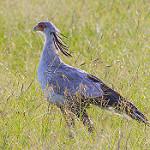
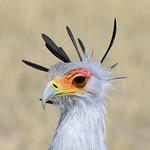
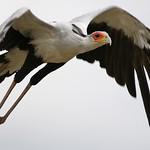
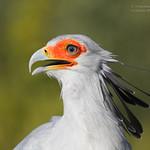
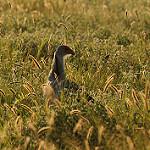
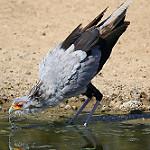
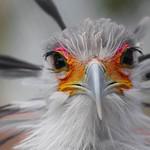
The Secretarybird is one of the most distinctive birds of prey in the world. A member of the order Accipitriformes, it stands out with its long crane-like legs, striking crest of black feathers, and terrestrial hunting behavior. Found across sub-Saharan Africa, it plays an important ecological role as a skilled predator of snakes and other small animals.
Appearance and Characteristics
- Body length up to 1.2 m, wingspan up to 2 m, and weight around 4–5 kg.
- Recognized by its long gray legs, resembling those of a crane.
- The head features a distinctive crest of long black feathers.
- The beak is hooked and strong, adapted for tearing prey.
- Plumage is mostly gray, with black wings and a tail marked by white and black bands.
Habitat
The Secretarybird inhabits open landscapes — savannas, grasslands, and light woodlands. It avoids dense forests and mountainous regions but is often seen near farmlands where it finds plenty of rodents and reptiles. The species ranges from Senegal and Ethiopia down to South Africa.
Diet and Behavior
The diet of the Secretarybird primarily consists of snakes, including venomous species such as cobras and vipers. It kills them by striking with its strong legs and sharp claws. It also feeds on lizards, rodents, small birds, and large insects. This bird hunts mainly on foot, covering up to 20 km per day in search of prey.
Interesting Facts
- The name “Secretarybird” comes from its long head feathers, which resemble the quill pens secretaries once carried behind their ears in the 18th century.
- During hunting, the bird can move at speeds of up to 30 km/h.
- It appears on the national emblem of South Africa as a symbol of wisdom and power.
Breeding
The breeding season varies by region but usually coincides with the dry season. Secretarybirds form long-term pairs. They build large nests atop acacia or baobab trees, made of sticks and grass. The female lays 1–3 eggs, incubating them for about 45 days. Chicks fledge at around 10 weeks of age.
Conservation Status
The Secretarybird is listed as a Vulnerable species on the IUCN Red List. Major threats include habitat loss, poaching, and collisions with power lines. Conservation programs across Africa aim to stabilize and increase the population of this unique bird.
Photos and Sounds
On this page, you can access audio recordings of Secretarybird calls and high-quality photographs showcasing its elegant posture and distinctive anatomy.
Frequently Asked Questions
Why is it called a “Secretarybird”?
The name comes from its crest of long black feathers, reminiscent of the quill pens secretaries used to carry behind their ears in the 18th century.
Where does the Secretarybird live?
It lives in the open savannas and grasslands of sub-Saharan Africa, from Senegal to South Africa.
What does the Secretarybird eat?
Its diet includes snakes, lizards, rodents, and large insects. It is particularly known for hunting venomous snakes.
Is the Secretarybird dangerous to humans?
No, the Secretarybird poses no threat to humans and tends to avoid direct contact. It focuses on hunting reptiles and small animals.
- Synonyms Secretary-bird, Sekretary bird, Secretary Bird
- Old latin name for bird Gypogeranus africanus, Falco serpentarius
Secretarybirdbird sounds *
Where to see Secretarybird
- Breeding region Africa
- Breeding subregion widespread
- Angola
- Benin
- Botswana
- Burkina Faso
- Burundi
- Cameroon
- Central African Republic
- Chad
- Congo
- Congo (the Democratic Republic of the)
- Côte d'Ivoire
- Djibouti
- Equatorial Guinea
- Eritrea
- Eswatini
- Ethiopia
- Gambia
- Ghana
- Guinea-Bissau
- Kenya
- Lesotho
- Liberia
- Malawi
- Mali
- Mauritania
- Mozambique
- Namibia
- Niger
- Nigeria
- Rwanda
- Senegal
- Somalia
- South Africa
- South Sudan
- Sudan
- Tanzania
- Togo
- Uganda
- Zambia
- Zimbabwe
Species Name in Other Languages
| Language | Translation |
|---|---|
| Afrikaans | Sekretarisvoël, Sekretarisvoel |
| Azerbaijani | ilan quşu, ilancıl, katibə quşu, katib quşu |
| Basque | Hegazti idazkari |
| Belarusian | Птушка-сакратар |
| Bengali | হমক্রটাচয াচি , হমক্রটাচযফাডি |
| Bulgarian | Птица секретар |
| Catalan | secretari |
| Chinese | 蛇鷲, 蛇鹫, 鹭鹰 |
| Chinese (Traditional) | 蛇鷲 |
| Croatian | sekretar |
| Czech | Hadilov písar, hadilov písař |
| Danish | Sekretærfugl |
| Dutch | Secretarisvogel |
| Esperanto | Sekretarbirdo, Sekretaribirdo |
| Estonian | Kurgkotkas, kurgkotkas (sekretärlind) |
| Finnish | sihteerilintu, sihteeri |
| French | Serpentaire, Messager serpentaire, Secrétaire, Messager sagittaire |
| Frisian | Sekretarisfûgel |
| Galician | Serpentario |
| German | Sekretär |
| Greek | Γραμματεύς |
| Hebrew | לבלר |
| Hungarian | kígyászkeselyű, Titkármadár |
| Icelandic | Örvi |
| Irish | Peannaire, Rúnai fadchosach |
| Italian | Serpentario, Segretario |
| Japanese | ヘビクイワシ |
| Kazakh | хатшы құс |
| Latvian | Sekretārs |
| Lithuanian | sekretorius |
| Luxembourgish | Sekretärvull |
| Norwegian | sekretærfugl |
| Norwegian Nynorsk | Sekretærfugl |
| Polish | sekretarz |
| Portuguese | secretário, Serpentário |
| Romanian | Secretar |
| Russian | Птица-секретарь, Секретарь |
| Serbian | Ptica sekretar, Sekretar |
| Shona | Hungwe |
| Slovak | hadožrút nohatý |
| Slovenian | Tajnik |
| Spanish | Secretario |
| Swahili | Karani Tamba |
| Swedish | sekreterarfågel |
| Tajik | паранда-секретар, парранда-секретар |
| Tatar | секретарь кошы , кятип кошы , секретарь-кош, сәркятип кошы |
| Tsonga | Mampfana |
| Tswana | Tlhamê |
| Turkish | Sekreterkuşu, Katip Kuşu, Kâtip kuşu |
| Ukrainian | секретар |
| Uzbek | мирзо қуш, мирзоқуш |
| Welsh | Aderyn y Cwils |
| Xhosa | Ingxangxosi |
| Zulu | iNtungunono |