New DiBird mobile app is now available — iOS & Android
Better on the app — your life list in your pocket. Download DiBird free
Horned Lark — identification, behavior and habitat overview LC
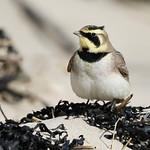
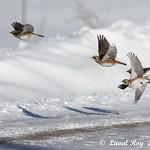
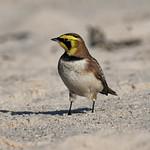
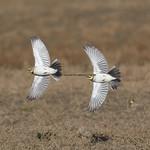
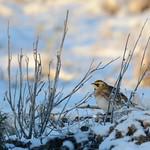
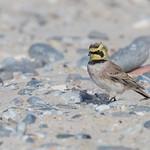
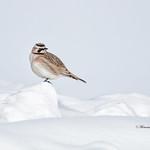
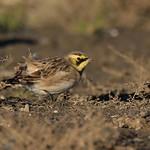
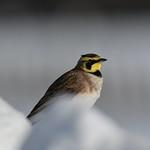
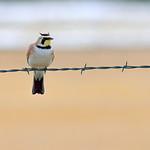
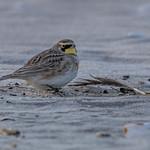
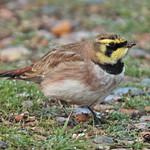
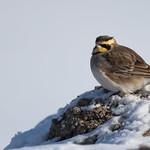
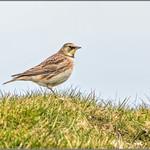
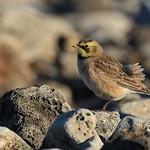
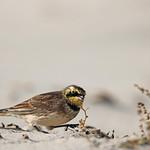
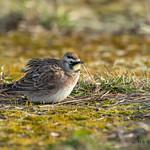
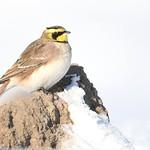
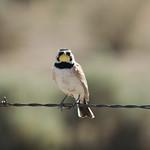
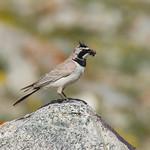
Horned Lark (Eremophila alpestris) is one of the most distinctive lark species, easily recognized by its small feathered “horns.” This ground-dwelling bird of open landscapes occurs across the Northern Hemisphere and is often searched for under queries such as “lark with horns,” “horned lark photos,” and “Eremophila alpestris call.”
Appearance and key features
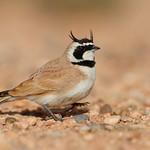
The Horned Lark is a compact, sandy-colored passerine with dark facial markings and characteristic upright feather tufts. Males become especially striking during the breeding season, showing a sharp contrast of black and white patterns.
- Length: approx. 16–20 cm
- Plumage: sandy brown with black and white accents
- Distinctive trait: two small feather “horns” on the head
- Sexual dimorphism: males display more contrasting facial masks
Distribution and habitat
The species ranges across North America, Eurasia, and parts of North Africa. It favors open, treeless environments where it can forage and nest on the ground.
- tundra and arctic plains
- steppes and semi-deserts
- sandy flats and coastal beaches
- open farmlands and grasslands
Behavior and diet
Horned Larks spend most of their time on the ground, running in short bursts while searching for food. Their diet varies with the season and habitat.
What Horned Larks eat
- grass and weed seeds
- small insects
- arachnids
- larvae and small invertebrates
Breeding
Males perform aerial song flights, producing melodious trills. The nest is placed directly on the ground and camouflaged carefully. Females lay 2–5 eggs, which they incubate for about two weeks.
Vocalization
The Horned Lark’s song is bright, melodic and composed of soft, tinkling notes. Audio recordings are available on this page of your website.
Interesting facts
- one of the most widespread lark species in the Northern Hemisphere
- “horns” are most prominent in males during the breeding season
- known for song flights during courtship
- in harsh climates the diet shifts almost entirely to seeds
Horned Lark FAQ
Where do Horned Larks live?
Horned Larks occur across North America, Europe, Asia, and parts of North Africa. They inhabit tundra, steppes, semi-deserts, and other open, low-vegetation landscapes.
Why are they called Horned Larks?
The name comes from the small black feather tufts on the male’s head, which look like tiny horns — especially visible during the breeding season.
What do Horned Larks eat?
Their diet consists mainly of seeds and small insects. In summer they feed more on invertebrates; in winter they shift primarily to seeds.
How can you identify a Horned Lark?
By its sandy coloration, dark facial markings, and characteristic feather “horns.” Males show sharply defined black masks and a yellowish face.
- Synonyms Horned or Przewalski's Lark, Horned Lark/Shorelark, Horned-Lark, Shore Lark, Shore horned lark
- Old latin name for bird Otocoris alpestris, Alauda alpestris, Eromophila alpestris
Horned Larkbird sounds *
Related species
Where to see Horned Lark
- Breeding region Eurasia, Middle America, North America
- Breeding subregion widespread
- Afghanistan
- Albania
- Algeria
- Armenia
- Austria
- Azerbaijan
- Bahamas
- Belarus
- Belgium
- Bermuda
- Bhutan
- Bosnia and Herzegovina
- Bulgaria
- Canada
- China
- Colombia
- Croatia
- Cyprus
- Czechia
- Denmark
- Estonia
- Faroe Islands
- Finland
- France
- Georgia
- Germany
- Greece
- Greenland
- Guernsey
- Hungary
- Iceland
- India
- Iran
- Iraq
- Ireland
- Isle of Man
- Israel
- Italy
- Japan
- Jersey
- Jordan
- Kazakhstan
- Kyrgyzstan
- Latvia
- Lebanon
- Lithuania
- Luxembourg
- Malta
- Mexico
- Moldova
- Mongolia
- Montenegro
- Morocco
- Nepal
- Netherlands
- North Macedonia
- Norway
- Pakistan
- Palestine, State of
- Poland
- Portugal
- Qatar
- Romania
- Russia
- Saint Pierre and Miquelon
- Serbia
- Slovakia
- Slovenia
- South Korea
- Spain
- Svalbard and Jan Mayen
- Sweden
- Switzerland
- Syria
- Tajikistan
- Turkey
- Turkmenistan
- Ukraine
- United Kingdom
- United States of America
- Uzbekistan
- Åland Islands
Horned Lark subspecies (42)
| Subspecies | Breeding subregion | Nonbreeding subregion | Extinct |
|---|---|---|---|
| Eremophila alpestris actia | coastal mountains of s California (w USA) and n Baja California (nw Mexico) | - | No |
| Eremophila alpestris adusta | s Arizona and s New Mexico (sw USA); nc Mexico? | - | No |
| Eremophila alpestris albigula | ne Iran and Turkmenistan to nw Pakistan | - | No |
| Eremophila alpestris alpestris | e Canada | se USA | No |
| Eremophila alpestris alpina | mountains of w Washington (nw USA) | - | No |
| Eremophila alpestris ammophila | deserts of se California and sw Nevada (sw USA) | - | No |
| Eremophila alpestris aphrasta | Chihuahua and Durango (nw Mexico) | - | No |
| Eremophila alpestris arcticola | n Alaska to British Columbia (w Canada) | to w USA | No |
| Eremophila alpestris argalea | extreme w China | - | No |
| Eremophila alpestris atlas | Morocco | - | No |
| Eremophila alpestris balcanica | s Balkans and Greece | - | No |
| Eremophila alpestris bicornis | Lebanon to Israel-Syria border | - | No |
| Eremophila alpestris brandti | se European Russia to w Mongolia and n China | - | No |
| Eremophila alpestris chrysolaema | wc to ec Mexico | - | No |
| Eremophila alpestris diaphora | s Coahuila to ne Puebla (nc, e Mexico) | - | No |
| Eremophila alpestris elwesi | s, e Tibetan Plateau | - | No |
| Eremophila alpestris enertera | c Baja California (nw Mexico) | - | No |
| Eremophila alpestris enthymia | sc Canada to Oklahoma and Texas (c USA) | to n Mexico | No |
| Eremophila alpestris flava | n Europe and n Asia | - | No |
| Eremophila alpestris giraudi | coastal sc USA and ne Mexico | - | No |
| Eremophila alpestris hoyti | n Canada | to n USA | No |
| Eremophila alpestris insularis | islands off s California (w USA) | - | No |
| Eremophila alpestris khamensis | sw, sc China | - | No |
| Eremophila alpestris kumerloevei | w, c Asia Minor | - | No |
| Eremophila alpestris lactea | Coahuila (nc Mexico) | - | No |
| Eremophila alpestris lamprochroma | inland mountains of w USA | - | No |
| Eremophila alpestris leucansiptila | deserts of s Nevada, w Arizona (sw USA) and nw Mexico | - | No |
| Eremophila alpestris leucolaema | s Alberta (sw Canada) through nc and c USA | to n Mexico | No |
| Eremophila alpestris longirostris | ne Pakistan and w Himalayas | - | No |
| Eremophila alpestris merrilli | w coast of Canada and USA | - | No |
| Eremophila alpestris nigrifrons | ne Qinghai (wc China) | - | No |
| Eremophila alpestris oaxacae | s Mexico | - | No |
| Eremophila alpestris occidentalis | n Arizona to c New Mexico (sw USA) | to n Mexico | No |
| Eremophila alpestris penicillata | e Turkey and the Caucasus to Iran | - | No |
| Eremophila alpestris peregrina | Colombia | - | No |
| Eremophila alpestris praticola | se Canada and ne, ec USA | - | No |
| Eremophila alpestris przewalskii | n Qinghai (wc China) | - | No |
| Eremophila alpestris rubea | c California (w USA) | - | No |
| Eremophila alpestris sierrae | mountains of ne California (w USA) | - | No |
| Eremophila alpestris strigata | coastal s British Columbia (w Canada) to coastal Oregon (w USA) | - | No |
| Eremophila alpestris teleschowi | w and wc China | - | No |
| Eremophila alpestris utahensis | mountains of wc USA | - | No |
Species Name in Other Languages
| Language | Translation |
|---|---|
| Afrikaans | Oorlewerik |
| Albanian | Lauresha e brigjeve, Lauresha me brirë |
| Arabic | قبرة مقرنة |
| Armenian | Եղջրավոր Արտույտ, Եղձրավոր Արտույտ, [Yeghjravor Artuyt ] |
| Azerbaijani | Buynuzlu torağay |
| Basque | Elur-pirripio, Alosa banyuda |
| Belarusian | Рагаты жаўрук, Жаваранак рогаты |
| Breton | An alc'hweder kornek, Alc'hweder kornek |
| Bulgarian | Алпийска чучулига, Ушата чучулига |
| Catalan | Calàndria comú, alosa banyuda |
| Chinese | 角百灵, [jiao bai-ling], 陆地百灵, 土画眉, 角百靈, [ludi bai-ling] |
| Chinese (Traditional) | 陸地百靈, 土畫眉, 角百靈 |
| Cornish | Awhesyth treth |
| Croatian | planinska ševa |
| Czech | Skrivan ouškatý, skřivan ouškatý, skøivan ouškatý |
| Danish | Bjerglærke |
| Dutch | Strand leeuwerik, Strandleeuwerik |
| Esperanto | montalaûdo, Montalaŭdo |
| Estonian | sarviklõoke |
| Faroese | Knavalerkur |
| Finnish | tunturikiuru |
| French | Alouette oreillarde, Alouette haussecol, Alouette hausse-col ou A. de Przewalski, Alouette cornue, Alouette de la Sibérie, Alouette hausse-col |
| Frisian | Strânljurk |
| Galician | Calandra cornuda europea, Calandra cornuda, Alosa banyuda , Laverca cornuda |
| Georgian | რქოსანი ტოროლა, რქიანი ტოროლა |
| German | Ohrenlerche |
| Greek | Χιovάδα, Χιονάδα |
| Hebrew | צחיחנית חרמון, צחיחנית החרמון |
| Hungarian | Fülespacsirta, havasi fülespacsirta |
| Icelandic | Fjallalævirki |
| Inuktitut | Tingodluktuk, Qutsissormiutaq |
| Irish | Fuiseog Adharcach |
| Italian | Allodola golagialla |
| Japanese | ハマヒバリ |
| Kazakh | Құлақты бозторғай |
| Korean | 해변종다리 |
| Latvian | ausainais cīrulis |
| Lithuanian | geltongurklis raguotasis vieversys, Raguotasis vieversys |
| Luxembourgish | Ouereléierchen |
| Macedonian | Планински (Ушлеста) чучулига, ушеста чучулига |
| Maltese | Alwetta Safra |
| Manx | Ushag eairkagh, Fushag ny traieyn |
| Mongolian | Эвэрт болжмор, Шоорон эвэртболжмор, Шоорон алаг болжмор |
| Nepali | जुरे भारद्वाज |
| Northern Sami | Ruoššaállat |
| Norwegian | fjellerke, Berglerke |
| Norwegian Nynorsk | Fjellerke |
| Persian | چکاوک شاخدار |
| Polish | Laverca, Górniczek zwyczajny, górniczek (zwyczajny), górniczek |
| Portuguese | Cotovia-cornuda, calhandra-cornuda, cotovia cornuda |
| Romanian | Ciocârlie urechiată, Ciocârlie urecheată |
| Romansh | Lodola puppenmellen |
| Russian | Рогатый жаворонок, рюм, Rogaty Zhavoronok, Рогатый жаворонок, рюм, Жаворонок рогатый, Рогатый жаворонок (рюм) |
| Serbian | Ušata ševa, Ушата (Планинска) шева, planinska ševa, Planinska ušata ševa, Ушата шева, Планинска шева |
| Slovak | škovránok ušatý, Ušárik vrchovský, uškárik vrchovský, škovránok ušatý (uškárik vrchovský), Ékovránok ušatý |
| Slovenian | uhati škrjanec |
| Spanish | Alondra Cornuda Lapona, Alondra cornuda |
| Swedish | berglärka |
| Turkish | kulakly toygar, Kulaklı Toygar, Құлақты бозторғай |
| Ukrainian | Рогатий жайворонок, жайворонок рогатий, Жайворонок рогатий , Рогатий (Полярний) жайворонок |
| Welsh | Ehedydd y treath, Ehedydd y traeth, Ehedydd traeth |