New DiBird mobile app is now available — iOS & Android
Better on the app — your life list in your pocket. Download DiBird free
Grey Partridge / Perdix perdix LC
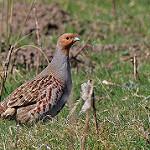
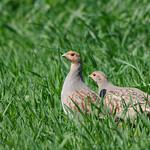
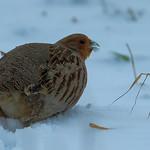
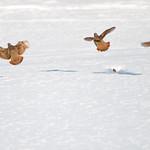
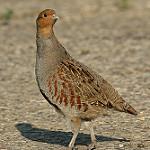
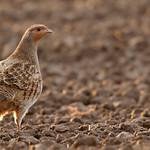
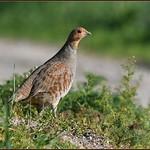
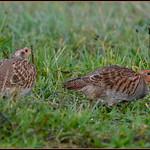
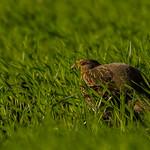
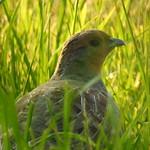
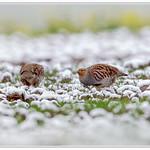
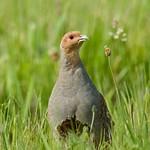
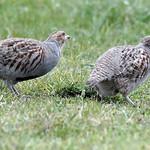
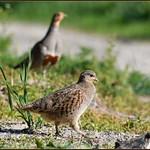
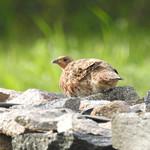
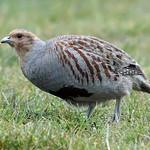
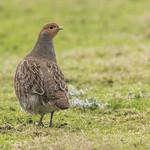
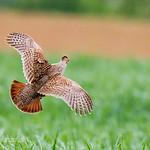
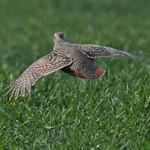
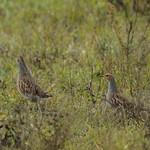
The Grey Partridge (Perdix perdix) — also known as the English Partridge — is a small ground-dwelling bird of the pheasant family (Phasianidae). Native to Europe and parts of Asia, it is a key indicator of farmland biodiversity and a beloved species among birdwatchers and gamekeepers alike. Though modest in appearance, it plays an important ecological role in traditional agricultural landscapes.
Identification and Appearance
The Grey Partridge measures around 28–32 cm in length, with a wingspan of 45–48 cm and a weight of 300–600 grams. Its plumage is cryptically patterned in brown, grey and chestnut tones — perfect camouflage against dry grass and soil. The male typically shows a distinctive dark chestnut horseshoe-shaped patch on the belly, while the female is paler and lacks this mark.
The head is round, the bill short and strong, and the legs are pinkish-grey. Its call is a sharp, rasping “kir-rick” often heard at dawn or dusk.
Range and Habitat
The Grey Partridge has a wide Palearctic range, stretching from Ireland and western France across central Europe to western Siberia and northern Iran. In the UK, it remains a traditional farmland species, although its numbers have declined in intensive agricultural areas. In Russia, Belarus and Ukraine, it is still a common breeding bird of open fields and steppe zones.
Preferred habitats include open grasslands, steppe, meadows and cultivated farmland. The bird avoids dense forests and high mountains, choosing areas with cover such as hedgerows, grassy field margins and small shrubs. During winter, coveys of 10–20 birds often feed together in stubble fields or near farmyards.
Diet and Feeding Habits
What do Grey Partridges eat? The species is mainly vegetarian, feeding on weed seeds, cereal grains, and green leaves. During spring and summer, insects such as beetles and caterpillars become vital components of their diet — especially for chicks, which need a protein-rich diet in their first weeks of life.
In winter, they switch to seeds and buds, scratching the ground or digging through light snow to find food. Their adaptability allows them to survive in harsh agricultural landscapes, provided there is enough natural vegetation left for shelter.
Behavior and Lifestyle
The Grey Partridge is a non-migratory, ground-dwelling species. It runs swiftly through tall grass and only takes flight when startled, flying low and straight with rapid wingbeats. Unlike pheasants, it rarely perches in trees. Pairs or small family groups are common during the breeding season, while larger coveys form in autumn and winter.
Partridges roost on the ground, often in shallow depressions or under shrubs. In cold climates, they may even burrow slightly into the snow to conserve heat. Their cryptic coloration and stillness make them nearly invisible to predators.
Breeding and Nesting
Breeding begins in late spring. Males establish small territories and advertise with loud calls. The species is monogamous: pairs stay together throughout the season. Nests are simple scrapes in the ground, lined with grass and leaves, usually hidden in tall vegetation or at field edges.
A clutch contains 10–15 olive-brown eggs, which the female incubates for about 23–25 days. The chicks are precocial — covered with down and able to feed themselves within hours of hatching. Both parents guard the brood, leading them to feeding areas rich in insects.
Predators and Threats
Main predators include foxes, stoats, crows, and birds of prey. However, the greatest threat to Grey Partridges comes from human activity: modern farming practices, pesticide use, and the loss of hedgerows and wildflower strips have severely reduced their numbers in Western Europe.
According to the IUCN Red List, the species is classified as Least Concern, but local populations in the UK, France, and Germany have declined drastically since the 1950s. Conservation programs encouraging wildlife-friendly agriculture — such as field margins and seed plots — have proven effective for restoring numbers.
How to Identify the Grey Partridge
The Grey Partridge can be confused with the Daurian Partridge (Perdix dauurica), which has a more rufous face and darker flanks. It is also larger and distributed further east. The Common Quail is smaller, has a shorter tail, and a very different, whistled call. In flight, the Grey Partridge shows a rounded body and chestnut tail feathers.
Interesting Facts
- Pairs are monogamous and stay together throughout the breeding season.
- The species was once a common symbol of autumn and harvest in European folklore.
- Partridges often take dust baths to clean their plumage.
- Chicks can walk and feed themselves within hours after hatching.
Frequently Asked Questions
Where do Grey Partridges live?
They inhabit open farmlands, grasslands and steppe regions across Europe and western Asia. They prefer low vegetation, avoiding dense forests and urban areas.
What do Grey Partridges eat?
Adults feed mainly on seeds, grains and green shoots, while chicks depend on insects for the first few weeks. They also eat buds and weed seeds during winter.
Can Grey Partridges be bred in captivity?
Yes. They are successfully bred in wildlife farms and game estates, provided they are given enough space, natural cover, and balanced feed.
How to tell male and female apart?
Males are slightly larger with a dark horseshoe patch on the belly, while females are paler and lack this feature.
What is the conservation status?
Globally listed as Least Concern by the IUCN, but declining locally due to habitat loss and pesticide use. Conservation actions focus on sustainable agriculture and habitat restoration.
- Synonyms Partridge, Gray Partridge, Hungarian partridge, European Partridge, Common Partridge
- Old latin name for bird Perdix vulgaris, Tetrao perdix, Perdix cinerea
Grey Partridgebird sounds *
Related species
Where to see Grey Partridge
- Breeding region Eurasia
- Breeding subregion w, wc
- Albania
- Andorra
- Armenia
- Austria
- Azerbaijan
- Belarus
- Belgium
- Bosnia and Herzegovina
- Bulgaria
- Canada
- China
- Croatia
- Czechia
- Denmark
- Estonia
- Finland
- France
- Georgia
- Germany
- Greece
- Hungary
- Iran
- Ireland
- Isle of Man
- Italy
- Kazakhstan
- Kyrgyzstan
- Latvia
- Liechtenstein
- Lithuania
- Luxembourg
- Moldova
- Montenegro
- Netherlands
- New Zealand
- North Macedonia
- Norway
- Poland
- Portugal
- Romania
- Russia
- Serbia
- Slovakia
- Slovenia
- Spain
- Sweden
- Switzerland
- Turkey
- Ukraine
- United Kingdom
- United States of America
- Uzbekistan
- Åland Islands
Grey Partridge subspecies (8)
| Subspecies | Breeding subregion | Nonbreeding subregion | Extinct |
|---|---|---|---|
| Perdix perdix armoricana | w, s France | - | No |
| Perdix perdix canescens | Turkey to the Caucasus and nw Iran | - | No |
| Perdix perdix hispaniensis | ne Portugal and n Spain | - | No |
| Perdix perdix italica | Italy | - | Yes |
| Perdix perdix lucida | Finland to the Ural Mts. and n Caucasus | - | No |
| Perdix perdix perdix | s Scandinavia and Britain to Bulgaria and Greece | - | No |
| Perdix perdix robusta | Ural Mts. to sw Siberia and nw China | - | No |
| Perdix perdix sphagnetorum | ne Netherlands and nw Germany | - | No |
Species Name in Other Languages
| Language | Translation |
|---|---|
| Abkhazian | аҮӘырманџь |
| Afrikaans | Gryspatrys |
| Albanian | thëllëza e fushës |
| Armenian | Մոխրագույն Կաքավ, [Mokhraguyn Kakav ] |
| Azerbaijani | çiltoyuq, çil, Boz keklik, Boz kəklik |
| Bashkir | көртлөк, көртөк, ҡыр тауығы, һоро ағуна |
| Basque | Eper grisa, eper, Eper gris, Perdiu xerra |
| Belarusian | Курапатка шэрая, kurapatka, Шэра курапатка, Шэрая курапатка, Сiва курапатка, курапатка |
| Breton | Glujar, Ar glujar c'hris, Klujar, klujar c'hris |
| Bulgarian | jarebica, Яребица, Полска яребица |
| Catalan | perdiu, perdiu xerra |
| Chinese | [hui shan-chun], [zhu-ji], 竹鸡, 灰山鹑 |
| Chinese (Traditional) | 灰山鶉 |
| Chuvash | хир чăххи, вăрман чăххи, Сăрă хир чăххи |
| Cornish | grugyar |
| Cree | peeheisees |
| Croatian | Trcka, skvržulja, trčka, Trčka skvržulja |
| Czech | koroptev polní, koroptev |
| Danish | Agerhøne |
| Dutch | Patrijs |
| Esperanto | Ordinara perdriko, Perdriko, Griza perdriko |
| Estonian | Nurmkana / Põldpüü, nurmkana, hallfrankoliin (hall-frankoliinkana), Põldpüü |
| Faroese | akurhøna |
| Finnish | peltopyy |
| French | Perdrix grise, Perdrix européenne, perdrix, Perdrix hongroise |
| Frisian | patriis |
| Galician | Charrela, Perdiz charrela, Perdiu xerra |
| Georgian | გნოლი |
| German | Rebhuhn |
| Greek | Καμπίσια Πέρδικα, perdika, Καμπίσια πέρδικα, πέρδικα |
| Hebrew | חגלית, חוגלית אפורה |
| Hungarian | fogoly |
| Icelandic | Akurhæna, akurhænsn |
| Irish | charrela, patraisc, Peatraisc, perdiz charra, Cearc ghearr |
| Italian | Starna eurasiatica, Starna, Pernice grigia |
| Japanese | ヨアロッパヤマウズラ, ヨーロッパヤマウズラ |
| Kashmiri | [Chakor] |
| Kazakh | қоңыр құр, Сұр шіл |
| Latvian | laukirbe |
| Lithuanian | Laukų vištelė, Kurapkė, pilkoji kurapka, kurapka |
| Luxembourgish | Feldhong |
| Macedonian | полска еребица, еребица, erebica, Полска еребица |
| Maltese | perniċi, ħaġla, îaġla, ħaġla griża, ħaġliet |
| Manx | patrag, Kiark Rennee |
| Mongolian | төвдийн ятуу, Бор ятуу |
| Northern Sami | Bealdobakku |
| Norwegian | rapphøne |
| Norwegian Nynorsk | Rapphøne |
| Occitan | perditz |
| Persian | کبک چیل |
| Polish | kuropatwa (zwyczajna), kuropatwa zwyczajna, kuropatwa |
| Portuguese | Charrela-comum, Charrela, perdiz-cinzenta, Perdiz-cinzenta, perdiz, perdiz cinzenta |
| Romanian | potârniche, divlio-kaini, Potârniche |
| Romansh | pernisch, pernisch (grischa), pernisch grischa |
| Russian | seraja kuropatka, Куропатка серая, Seraya Kuropatka, Серая куропатка, Cерая куропатка |
| Sardinian | istarna, perdighe d'abba, perdixi cixinali |
| Serbian | Jarebica, Јаребица, jаребица |
| Slovak | jarabica poľná, jarabica |
| Slovenian | poljska jerebica, jerebica |
| Spanish | perdiz, Perdiz pardilla, Perdix pardilla |
| Swedish | rapphöna |
| Tajik | кабки даштӣ |
| Tatar | кыр тавыгы, соры көртлек , соры кыр тавыгы |
| Turkish | çil keklik, Çilkeklik |
| Turkmen | çilkeklik |
| Ukrainian | Куріпка сіра , сiрая курiпка, Сіра куріпка, siraja kuripka, Ciрая курiпка, куріпка сіра |
| Uzbek | чил, бўз каклик, кулранг каклик, кичик кулранг каклик |
| Welsh | petrisen, Cor-iar, Coriar |